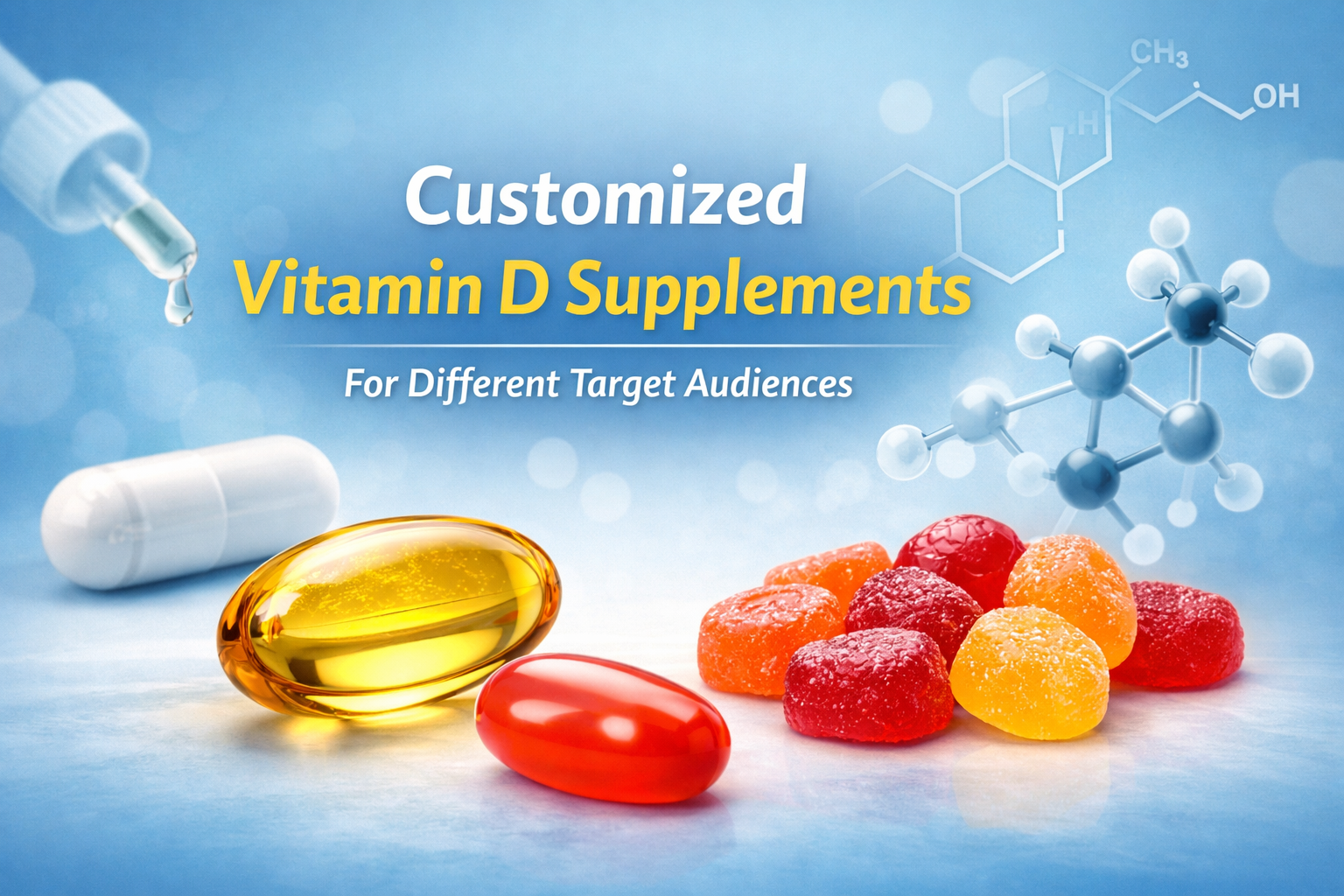
Vitamin D remains a cornerstone of the global dietary supplement market. While market size continues to surge and consumer awareness is at an all-time high, this maturity brings a challenge: intense commoditization. For modern brands, “one-size-fits-all” solutions are no longer enough to capture discerning consumers. Customization is the true growth engine for Vitamin D products. This guide explores how to strategically customize Vitamin D supplements across eight critical dimensions: target demographics, formulations, dosages, delivery formats, synergistic ingredients, branding, compliance, and manufacturing.
Why Customization Matters in the Vitamin D Supplements Market
1. The Shift Toward Personalized Nutrition
Modern consumers actively research product ingredients and seek solutions that are “tailored for them.” Standardized vitamin D products are caught in a price war, severely compressing profit margins.
2. Customized Vitamin D Supplements Help Brands Stand Out
Through customization, you can create a unique selling proposition (USP), such as a “D3+K2 formula designed specifically for menopausal women.” This precise targeting significantly increases customer repurchase rates and brand loyalty.
3. Customization Increases the Perceived Value of Your Supplement Brand
Customized products naturally support higher price points, conveying a professional, scientific, and high-end brand image, making it easier to gain consumer trust.
Understanding Your Target Audience Before Customization
1. Children: The “Healthy Growth” Segment
For pediatric supplements, the parent is the buyer, but the child is the user. Success depends on balancing safety with palatability.
- Core Focus: Bone development, immune defense, and height growth.
- Key Features: Delicious flavors (berry/citrus), gummy or liquid formats, and zero artificial colors or flavors.
- Marketing Hook: Safety certifications and precise, low-dose “peace of mind” for parents.
2. Adults & Office Workers: The “Lifestyle Support” Segment
This group suffers from “indoor syndrome”—lack of sunlight due to sedentary desk jobs.
- Core Focus: Sub-health recovery, immune resilience, and mood regulation (the “sunshine vitamin”).
- Key Features: High-potency formulas, convenient travel-friendly packaging, and combinations with mood-supportive ingredients.
- Marketing Hook: “A daily dose of sunshine for the modern professional.”
3. Seniors: The “Longevity & Mobility” Segment
As the body ages, absorption efficiency drops and bone density becomes a critical safety concern.
- Core Focus: Preventing osteoporosis, reducing fall risk, and supporting cardiovascular health.
- Key Features: Highly bioavailable liquid drops or easy-to-swallow small softgels.
- Synergy: Almost always paired with Calcium and Vitamin K2 for directed bone absorption.
4. Athletes & Active Lifestyles: The “Performance” Segment
Athletes put immense strain on their skeletal and muscular systems, requiring more than just the baseline RDA.
- Core Focus: Muscle function, rapid recovery, and stress fracture prevention.
- Key Features: Complex formulations featuring Magnesium, Zinc, or Collagen.
- Marketing Hook: “Engineered for peak performance and structural integrity.”
5. Women (Pregnancy & Menopause): The “Hormonal Health” Segment
Women’s nutritional needs shift dramatically during major biological milestones.
- Pregnancy: Focused on fetal skeletal development and maintaining maternal calcium balance.
- Menopause: Focused on mitigating bone loss due to estrogen decline and supporting heart health.
- Critical Factor: Clinical endorsements and “Clean Label” transparency are non-negotiable for this segment.
Vitamin D2 vs. D3: Choosing the Right Form for Your Market
When choosing a vitamin D supplement, understanding the differences between D2 and D3 is crucial. While both can increase vitamin D levels in the blood, they differ in their sources, effects, and market positioning.
Vitamin D2, also known as ergocalciferol, is the classic plant-derived form, typically produced by irradiating yeast or mushrooms with ultraviolet light. It is particularly suitable for strict vegetarians and vegans, making it an ideal choice for those seeking “cruelty-free” and purely plant-based options. However, it’s important to note that D2 has relatively lower bioavailability, and studies show it may not be as effective as D3 in maintaining long-term stable blood vitamin D levels.
Vitamin D3, or cholecalciferol, is considered the “gold standard” of vitamin D. It is not only the form naturally synthesized by the human skin when exposed to sunlight, but it also demonstrates more significant efficacy in raising and maintaining serum vitamin D levels, with a stronger and longer-lasting effect. Traditionally, D3 was extracted from lanolin, but now high-quality algae-derived D3 from sources like lichen is available on the market, offering a new option for vegetarians. In terms of market positioning, D3 is suitable for strategies emphasizing “high absorption,” “clinical-grade effects,” and “maximum bioavailability.”
Precision Dosing: Meeting Diverse Consumer Demands
Choosing the right International Unit (IU) level allows your brand to target specific life stages and health goals.
Low-Dose Vitamin D Supplements (400-800 IU)
Suitable as a daily basic supplement for children or as basic nutritional support for adults. The product label should clearly state the applicable age range (e.g., “Children aged 1 year and older and adults”), and emphasize its safe and gentle characteristics, making it an ideal entry point for establishing a daily supplementation habit.
Standard-Dose Vitamin D Supplements (1000-2000 IU)
Meets the daily needs of most adults for maintaining bone and immune health. As a mainstream market choice, its safety has been widely verified, making it a convenient, reliable, and cost-effective option for consumers who prioritize daily health maintenance.
High-Potency Vitamin D Supplements (5000 IU+)
Suitable for individuals diagnosed with deficiency/insufficiency, those with malabsorption issues, or specific high-risk groups. It must be clearly labeled “Use under the guidance of a doctor or nutritionist,” and emphasize its targeted corrective use, not for daily general health maintenance.
Daily vs. Weekly Dosage Forms
Daily: Small doses taken daily help integrate into daily life and form healthy habits, suitable for those who pursue regular health maintenance.
Weekly: A single dose provides a week’s supply, greatly improving convenience and long-term adherence. It’s an ideal choice for forgetful individuals or those seeking efficiency, and a key point of product differentiation.
Selecting the Most Effective Vitamin D Supplement Format
Choosing the right delivery format is crucial for efficacy, consumer preference, and market positioning.
| Format | Key Benefits & Market Position | Ideal For |
| Softgels (Oil-Based) | The ideal carrier for fat-soluble Vitamin D, ensuring high absorption and bioavailability. The clear, premium appearance supports a high-end or professional-grade market position. | Adults focused on optimal efficacy, premium market segments. |
| Liquid Drops & Sprays | Offers rapid absorption, flexible dosing, and requires no swallowing. The format allows for precise, personalized intake. | Infants, toddlers, individuals with swallowing difficulties, or those needing adjustable doses. |
| Gummies & Chewables | Provides a great taste and enjoyable experience, significantly improving compliance. Appeals directly to sensory preferences. | Children, teenagers, and young adults who prefer a tasty, routine-friendly option. |
| Capsules & Tablets | A cost-effective format with a mature, stable production process. Familiar and convenient for most consumers. | The mainstream market, value-conscious consumers, and traditional product lines. |
Enhancing the Formula with Complementary Ingredients
Science-backed combinations add significant value and target specific health needs.
| Formula Combination | Core Scientific & Market Value | Target Market |
| Vitamin D + Calcium | The classic bone health synergy. Vitamin D is essential for the efficient absorption of calcium, strengthening the core “bone support” message. | The foundational market for women and older adults concerned with maintaining bone density. |
| Vitamin D + Vitamin K2 (MK-7) | The advanced directional formula. K2 helps direct calcium into bones and teeth while supporting its removal from soft tissues, a key selling point for sophisticated consumers. | Discerning buyers seeking high-end, science-driven formulations for long-term skeletal and cardiovascular health. |
| Vitamin D + Magnesium | A fundamental metabolic partnership. Magnesium is required for the activation and utilization of Vitamin D in the body, supporting overall energy metabolism and nervous system function. | Health-aware individuals interested in holistic metabolic support, stress management, and improved sleep. |
| Immune Support Blends (e.g., D + C + Zinc + Elderberry) | Creates high-demand seasonal products. Addresses the strong consumer desire for comprehensive immune system support in a convenient single product. | A broad audience looking for preventive, seasonal wellness solutions. |
Packaging and Branding Customization
Packaging Formats: Economical bulk bottling; individual blister packs enhance portability and freshness; single-serving sachets are ideal for sports or travel.
Label Design and Compliant Claims: Ensure all health claims comply with FDA/EFSA regulations. Designs must clearly communicate customized value (e.g., “50+ Exclusive Formula”).
Market-Specific Branding Strategies:
- E-commerce (e.g., Amazon): Eye-catching main images and titles containing key search terms.
- High-end offline retail: Packaging materials and design must reflect quality and sophistication.
Regulatory and Compliance Considerations
Vitamin D Supplements Regulations in the US (FDA/DSHEA): Products must comply with GMP standards and be labeled as “dietary supplements,” prohibiting claims of treating diseases.
EU and Global Compliance (EFSA): Note the daily upper limit for Vitamin D set by EFSA; labels must comply with local language and nutritional information format requirements.
Third-Party Testing and Certifications: GMP, Non-GMO, Vegan, and Gluten-Free certifications are important endorsements, especially for high-end and specialized products.
Partnering with a Professional Vitamin D Supplements Manufacturer
OEM vs. ODM: Finding Your Fit
ODM (Original Design Manufacturing): The factory provides complete ready-made or customized solutions, including formulation, dosage form, production, and packaging. The brand only needs to label and sell the product, making it ideal for startups or brands seeking rapid market entry.
OEM (Original Equipment Manufacturing): The brand already has a mature formula, dosage form design, and product positioning. The factory only manufactures, fills, and packages according to the brand’s requirements, making it best suited for established brands with unique intellectual property.
MOQ, Lead Time, and Cost Factors
Understand minimum order quantities and lead times. Experienced supplement contract manufacturers can offer flexible solutions for brands of different sizes.
Quality Control and Traceability
Quality is the lifeline of a product. Before partnering, ensure the manufacturer possesses the following systems:
- Complete raw material traceability: Ensuring transparency from source to finished product.
- Strict batch testing: Detailed ingredient analysis reports should be provided for each batch.
- Compliance assurance: Production facilities and processes must comply with quality system certifications required by the target market, such as Good Manufacturing Practices (GMP).
Conclusion
In a competitive vitamin D market, deep customization is key to transforming product competition into solution-based competition. This requires a brand to deeply understand its audience and, with the support of a professional manufacturing partner, translate those insights into safe, effective, compliant, and market-ready products.
Ready to Create Your Own Line of Custom Vitamin D Supplements?
As a leading provider of Private Label Vitamin Supplement Manufacturing, we offer end-to-end solutions—from custom formulation development and flexible dosage forms (softgels, gummies, tablets) to compliant packaging and stringent quality control. Let’s transform your vision into a market-ready product. Contact us today for a free consultation and quote!