Cognitive health has become a top priority for consumers worldwide. Increasing work pressure, digital fatigue, aging populations, and a growing focus on mental performance are driving strong demand for supplements for cognition, including memory, focus, and stress-resilience products.
According to industry forecasts, the global cognitive supplements market is expected to continue steady growth through 2026, with natural ingredients, combination formulas, and personalized nutrition leading the way.
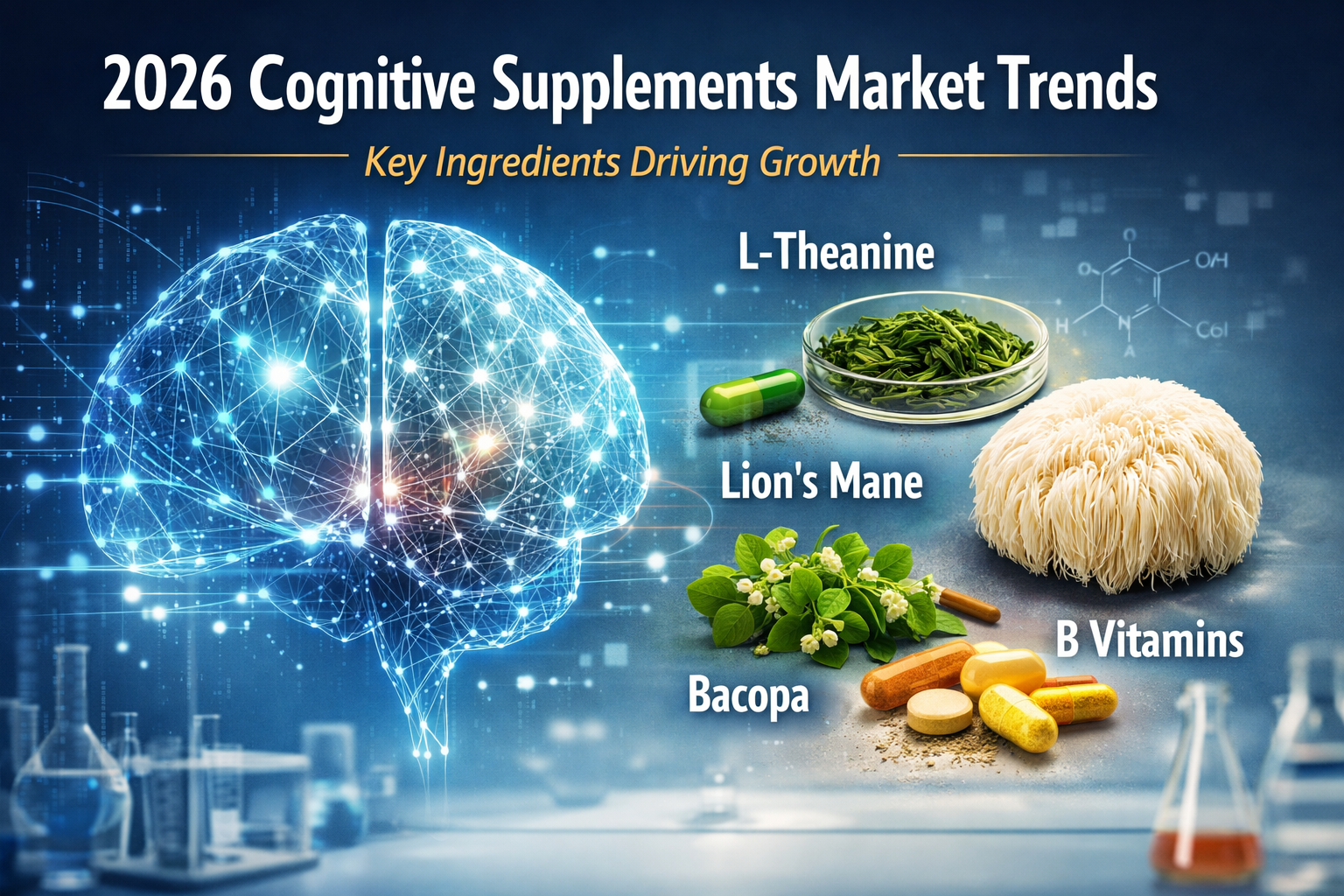
In this article, we explore the most popular cognitive supplement ingredients in 2026 and what these trends mean for brands.
Global Cognitive Supplement Market Overview
By 2026, the cognitive supplement market has completed its evolution from “single-ingredient” products to “complex formulas.” The market is primarily categorized into three segments:
- Immediate Performance: Emphasizes focus, reaction speed, and short-term memory.
- Emotional Regulation: Targets anxiety, brain fog, and cognitive maintenance under stress.
- Neuroprotective: Focuses on long-term brain health, anti-inflammation, and the prevention of cognitive decline.
Insights into Core Consumer Demands
Research indicates that “Calm Focus” has replaced simple “caffeine-induced stimulation” as the most searched consumer demand keyword in 2026.
Most Popular Cognitive Supplement Ingredient Trends for 2026
| Ingredient Category | Representative Ingredients | Core Function & Positioning | Key Data & Trends | Primary Consumer Groups |
| Amino Acids | L-Theanine | “Calm Alertness,” reduces anxiety while enhancing focus. | Market size ~$120M in 2024; Often combined with caffeine. | High-pressure professionals, students |
| Functional Mushrooms | Lion’s Mane, Reishi | Neuroprotection, promotes NGF, improves memory. | Significant growth in Europe, CAGR 11.09%. | Young & middle-aged adults focused on long-term brain health & natural wellness. |
| Adaptogenic Herbs | Ashwagandha, Rhodiola Rosea | Helps the body adapt to stress, improves stress-related fatigue & cognitive wear. | Global adaptogen market projected to reach $22.46B by 2034. | Individuals under chronic stress, those seeking emotional balance. |
| Traditional Cognitive Herbs | Bacopa monnieri | Enhances memory, learning ability; modernization of traditional Ayurvedic herb. | Market size ~$2.5B in 2024; Cognitive benefits supported by clinical research. | Students, middle-aged/older adults experiencing early memory decline. |
| Foundational Nutrients | B-Vitamins, Magnesium | Supports brain cell energy metabolism; cornerstone of “comprehensive brain health” formulas. | Frequently appears as a core component of complex formulas. | General public, those focused on foundational health. |
1. L-Theanine
L-Theanine is a non-protein amino acid naturally found in tea leaves. It significantly enhances relaxation and focus without causing drowsiness.
Multiple studies have demonstrated that when used synergistically with caffeine, L-Theanine can effectively improve attention, reaction speed, and overall cognitive performance. This “calm yet alert” experience precisely meets the demand for efficient and stable focus among modern professionals and students, driving its rising popularity in the cognitive health supplement market.
2. Functional Mushrooms (e.g., Lion’s Mane)
The functional mushroom category, led by Lion’s Mane, is experiencing explosive growth. Lion’s Mane has garnered significant attention for its potential to stimulate the synthesis of Nerve Growth Factor (NGF) and support neuronal repair and long-term brain health.
The core driver of this growth is the high consumer preference for natural, whole-food-sourced ingredients. Simultaneously, technological innovation at the product level is accelerating, such as:
- Dual-extraction techniques to enhance the bioavailability of active compounds.
- Mycelium cultivation systems to improve sustainability and supply stability.
On social media, the buzz surrounding functional mushrooms continues to climb, successfully attracting young consumers who seek a blend of natural wellness and scientific nutrition.
3. Adaptogens (e.g., Rhodiola Rosea)
Adaptogens, such as Rhodiola Rosea and Ashwagandha, function by modulating the body’s stress response system (the HPA axis), helping the body better cope with chronic psychological and physical stress.
Against the backdrop of widespread chronic stress in modern society, adaptogens are viewed as essential tools for managing “stress-induced cognitive fatigue” and protecting long-term brain function. Consumers increasingly prefer comprehensive solutions that combine “stress management + cognitive enhancement,” steadily increasing the market share of adaptogens. For instance, Rhodiola Rosea has reached a monthly average search volume of 40,500, with a staggering year-over-year growth rate of 82%, signaling powerful market momentum.
4. Traditional Herbal Ingredients (e.g., Bacopa Monnieri)
Bacopa Monnieri has been used for thousands of years in Ayurvedic medicine as a brain-boosting herb to enhance memory, learning capacity, and alleviate anxiety.
Modern scientific research now provides strong validation for these traditional applications. A randomized, double-blind, placebo-controlled clinical trial published in 2024 showed that after 12 weeks of supplementing with standardized Bacopa extract, subjects achieved significant improvements across multiple dimensions, including short-term, spatial, and working memory.
This trend reflects a pivotal market shift: traditional herbal ingredients are achieving a “modern makeover” through rigorous scientific validation and advanced extraction technologies (such as patented processes for higher bioavailability), thereby earning the trust of mainstream global consumers. The Bacopa extract market is projected to maintain a Compound Annual Growth Rate (CAGR) of 7.5% from 2026 to 2033.
5. Vitamins and Minerals (B-Vitamins, Magnesium)
B-Vitamins (especially B6, B9, and B12) play a critical role in neurotransmitter synthesis, energy metabolism, and homocysteine regulation; they are the foundational nutrients for maintaining normal cognitive function.
Meanwhile, Magnesium—particularly high-bioavailability forms like Magnesium L-Threonate—has gained significant attention in the brain health sector due to its ability to effectively cross the blood-brain barrier, supporting synaptic plasticity, emotional stability, and sleep quality.
As consumer demands become more sophisticated, single-ingredient products are no longer sufficient to meet multi-dimensional brain health needs. The market is rapidly evolving toward “Comprehensive Brain Health Formulas.” A mainstream strategy for brands to create differentiated, high-efficacy products is to scientifically blend star ingredients like L-Theanine and Lion’s Mane with foundational nutrients like B-Vitamins and Magnesium.
6. Secondary Growth Ingredients
Beyond the core ingredients mentioned above, secondary growth components such as Omega-3 fatty acids, amino acids (e.g., GABA), and functional peptides are gradually gaining market traction. These are primarily utilized to:
- Enhance synergistic effects within complex formulas.
- Support personalized nutrition plans, addressing differentiated needs across mood regulation, memory support, or sleep improvement.
While these ingredients may not be the current primary focus of the market, they hold significant potential for long-term product innovation and the field of precision nutrition.
Why are these ingredients gaining popularity?
1. Changing Consumer Behavior
- Increased demand for focus and clear thinking among working professionals and students
- Growing concern among the aging population about preventing cognitive decline
2. Product Experience Innovation
Diversified product forms, including capsules, gummies, powders, and even functional beverages, meet the needs of different user experiences.
3. Personalization and Precision Nutrition
AI-assisted formulations and customized cognitive supplements supported by genetic/blood testing are emerging, providing new directions for brand differentiation.
4. Regulations and Supply Chain
Stricter regulations on dietary supplements globally are demanding higher standards for ingredient safety and label accuracy. At the same time, consumer concerns about raw material sustainability and transparent sourcing are driving supply chain upgrades.
Brand Strategy Insights: Seizing Trends to Create Value
In the increasingly competitive cognitive supplement market, brands must build a competitive edge through precise product positioning and innovative formulation.
1. Differentiated Formulation Strategy
A differentiated formulation strategy is the key to winning the market. Developing multi-ingredient formulas that combine adaptogens with focus-support components can directly address the core needs of modern professionals suffering from “stress-induced cognitive fatigue.”
Example: Combining Rhodiola Rosea with L-Theanine allows users to manage stress while maintaining a state of mental clarity and alertness.
2. Precise Positioning Across Life Cycles
Market opportunities can be maximized by targeting specific demographic groups based on their life cycle needs:
- Students: Focus on portable products that emphasize attention span and memory support.
- Professionals: Design daytime formulas tailored for stress management and high-level productivity.
- Seniors: Develop specialized products centered on long-term brain health maintenance and the prevention of cognitive decline.
3. Innovation in Delivery Formats
Diversifying product formats helps expand the user base beyond traditional consumers. In addition to standard capsules, brands should consider:
- Instant powders and functional beverages.
- Orally disintegrating tablets and nootropic gummies.
4. Marketing with Scientific Endorsement
Scientifically backed marketing materials are essential for building consumer trust. To establish strong brand credibility, promotional efforts should emphasize:
- Clinical research data and the specific mechanisms of action for key ingredients.
- The intersection of traditional usage history with modern science.
- Authentic user experience testimonials.
In social media marketing, communicating the scientific evidence and tangible effects in a concise, transparent manner is critical to conversion.
Summary
In 2026, the cognitive supplement market will continue to grow, with cognitive health products centered on natural ingredients, complex formulations, and personalized customization becoming a key area of brand competition. As consumer demand for brain health, focus, and long-term cognitive management continues to rise, the market is evolving from single-function products to more systematic and scientifically-based solutions.
For brands, choosing a cognitive supplement OEM/ODM partner with cutting-edge R&D capabilities, a rigorous quality control system, and a flexible supply chain will be a crucial step in seizing the market opportunities of 2026 and creating differentiated cognitive health products. In the future, the cognitive supplement market will become further segmented, with a product and service ecosystem centered around personalized brain health management gradually becoming the new competitive landscape.
Are you ready?
If you are planning your next competitive cognitive health supplement product, or wish to translate the above market trends into actionable product formulations and solutions, please feel to contact us. We provide one-stop solutions from market analysis and scientific formula development to compliant manufacturing, helping you accurately seize the opportunities in the 2026 cognitive health market.