If you’re building a supplement brand, it’s worth understanding that the regulatory ground under this industry isn’t as settled as it might seem. The core framework has held for three decades, but 2026 has brought some of the most significant regulatory activity the category has seen in years — and brand owners who understand what’s happening are better positioned than those who assume the rules never change.
The Legal Foundation: DSHEA, 1994
Nearly everything about how dietary supplements are regulated in the U.S. traces back to a single law: the Dietary Supplement Health and Education Act of 1994 (DSHEA). It established the legal definition of a “dietary supplement,” created the framework for what claims a product can and can’t make, and gave the FDA its regulatory authority over the category — including the current Good Manufacturing Practice (cGMP) requirements under 21 CFR Part 111 that govern how supplements are actually produced.
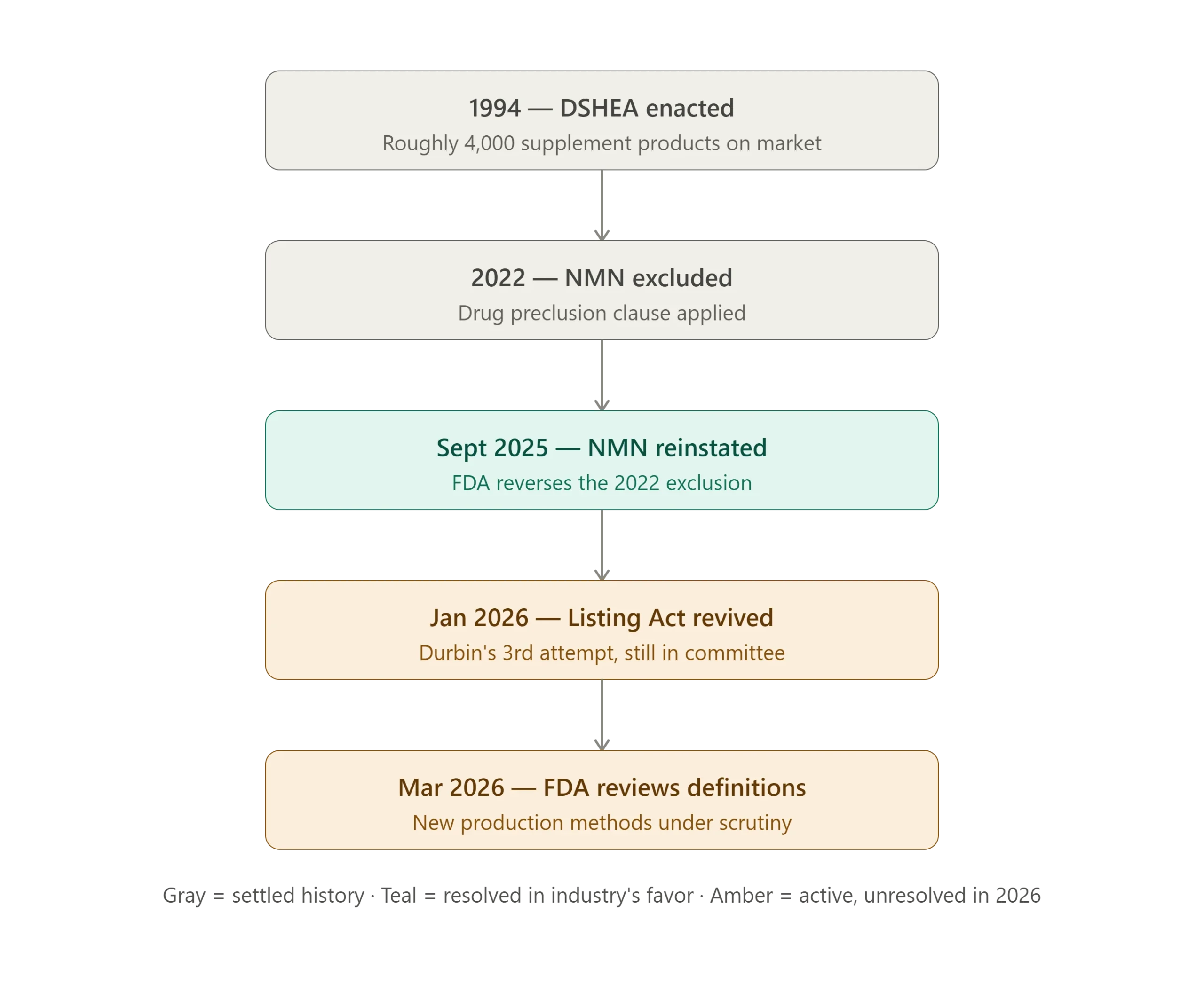
DSHEA was written for a much smaller industry than exists today. In 1994, there were roughly 4,000 dietary supplement products on the U.S. market. Today, FDA estimates put that number above 100,000. That growth — in scale, ingredient complexity, and manufacturing sophistication — is a big part of why 2026 has become a pivotal year for how this law gets interpreted and possibly updated.
What’s Actually Changing in 2026
The FDA is reassessing what counts as a “dietary substance.” In a public meeting held March 27, 2026, the FDA moved beyond routine compliance guidance and opened up a more fundamental question: how should DSHEA’s definition of a “dietary substance” apply to ingredients that didn’t exist — or weren’t consumed — when the law was written in 1994? The discussion specifically named newer production methods now drawing regulatory attention, including precision fermentation, cell culture, recombinant production, and synthetic production methods. As the supplement industry has expanded well beyond traditional vitamins and botanicals into fermentation-derived bioactives and engineered ingredients, the FDA is examining whether some of these ingredients require a different regulatory path altogether.

A federal product listing requirement is back on the table. Senator Dick Durbin reintroduced the Dietary Supplement Listing Act in January 2026 — his third attempt at this legislation. The bill would require dietary supplement manufacturers to formally register their products with the FDA, something DSHEA never mandated. Durbin’s argument is straightforward: without a registry, the FDA doesn’t have basic visibility into what’s actually being sold under the “dietary supplement” label across a market that’s grown 25-fold since 1994. As of mid-2026, the bill remains in committee, alongside other related legislative proposals — it hasn’t passed, but it’s a live conversation brand owners should track, not something to assume will quietly disappear.
FDA is reconsidering how supplement labels display required disclaimers. In a December 2025 letter to the industry, FDA signaled it’s open to amending the labeling regulation around DSHEA disclaimer placement — a smaller, more technical change, but one that shows the agency is actively revisiting rules that have gone unchanged for years.
What This Means If You’re Building a Supplement Brand
None of this changes what you need to do today — cGMP compliance, accurate labeling, and substantiated claims remain the baseline. But it does mean a few things worth keeping in mind:
Ingredient due diligence matters more than ever. If you’re formulating with a newer or less conventional ingredient — anything produced through fermentation, novel extraction methods, or biotechnology — it’s worth confirming its regulatory standing before you commit to it. NMN’s 2022 exclusion and 2025 reinstatement is a useful case study in how quickly an ingredient’s legal status can shift.
A manufacturing partner who tracks regulatory change is a real advantage. With the FDA actively reexamining foundational definitions and Congress debating a federal listing requirement, a contract manufacturer that treats compliance as a moving target — not a box checked once — is a meaningfully safer long-term partner than one that hasn’t updated its thinking since DSHEA was written

Building With a Compliance-Aware Manufacturing Partner
Ekang Nutra is a California-based, FDA-registered, cGMP-certified (independently certified by Eurofins Healthcare Assurance, accredited by ANAB under ISO/IEC 17065) dietary supplement manufacturer. We manufacture capsules and powders, plus tablet packaging and labeling, for brand owners who want a production partner that understands where this industry’s regulatory landscape is headed — not just where it’s been.
Have questions about how a regulatory change might affect your product line? Contact our team for a conversation.