“Anti-aging” used to mean skin cream. In the U.S. supplement industry today, it increasingly means something closer to preventive cellular science — and the market data, the ingredient pipeline, and the marketing language are all shifting to match.
How Big Is This Market, Actually?
Depends who you ask, and more specifically, what they’re counting. Estimates for the U.S. market range enormously depending on scope: reports focused narrowly on “anti-aging supplements” put the global market between roughly $4–6 billion for 202612, while reports using a broader “longevity and general wellness supplements” definition put the U.S. market alone at around $6.7 billion in 2026, projected to reach roughly $10 billion by 2033 — with the longevity-specific segment growing fastest, at nearly 9% annually.3 Broader “longevity market” estimates that also fold in clinics, diagnostics, and therapeutics (not just supplements) run considerably higher, into the tens of billions.4
The takeaway for brand owners isn’t any single number — it’s that regardless of methodology, every major report agrees on the same direction: sustained, above-average growth, driven by an aging population, rising preventive-health mindset, and expanding ingredient science.13
The Bigger Shift: From “Anti-Aging” to “Healthspan”
The more interesting story than the market size is the reframing happening within it. “Anti-aging” implies fighting a losing battle against time itself — and increasingly, both consumers and formulators are moving away from that framing toward healthspan: not living longer, necessarily, but staying functional, strong, and cognitively sharp for more of the years you have. Industry research now explicitly tracks this as a redefinition of the category, not just a marketing tweak.3
That shift shows up in what’s actually being formulated. Instead of a single “anti-aging” pill promising broad, vague benefits, the market has fragmented into more specific, credible positioning: cellular energy support, muscle and mobility maintenance, cognitive clarity, and skin structure — each backed by its own, more targeted ingredient science.
The Ingredient Landscape
A handful of ingredient categories are doing most of the work in this space right now:
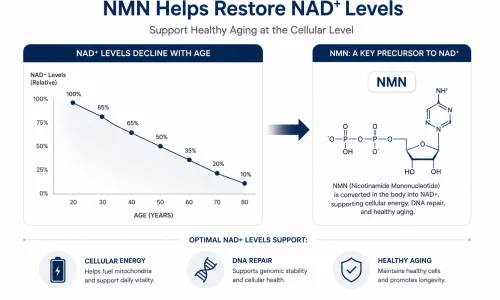
NAD+ precursors (NMN and related compounds). This has been one of the most closely watched — and most regulated — corners of the category. NMN was excluded from the legal definition of a dietary supplement in 2022, then reinstated by the FDA in September 2025, a reversal that industry analysts point to directly as a confidence-boosting signal for the entire NAD+ precursor segment.5 We covered this regulatory history, along with the ingredient’s research base and a significant raw-material quality problem worth knowing about, in a dedicated guide to NMN supplement manufacturing.
Collagen. Once positioned almost exclusively for skin, collagen has become a genuine cross-category healthy-aging ingredient — relevant to joint, bone, and connective-tissue health as much as appearance. We break down collagen types, sourcing considerations, and formulation positioning in more depth in our collagen supplement manufacturer guide.
Urolithin A. A newer entrant with a genuinely interesting research angle — mitochondrial function and muscle health — but also a sourcing consideration most trend pieces skip entirely: a significant patent landscape around the most clinically studied form of the ingredient. We cover what brand owners should ask before formulating with it in our Urolithin A manufacturing guide.
Resveratrol and other polyphenol antioxidants. A longer-standing category staple, frequently formulated alongside NAD+ precursors in combination longevity stacks, based on research interest in cellular oxidative stress and aging-related decline.
Vitamins, minerals, and foundational nutrients. It’s easy to overlook amid the more novel ingredients, but foundational nutrition — vitamin D, magnesium, B-complex — remains one of the largest segments within longevity-positioned supplementation, reflecting a market that hasn’t abandoned the basics even as it chases newer science.6
Personalization Is Becoming Part of the Category, Not a Separate Trend
One notable shift: longevity supplementation is increasingly intersecting with personalized nutrition. DNA testing, blood biomarker panels, and microbiome analysis are being used by a growing number of companies to recommend individualized supplement regimens rather than one-size-fits-all formulas.3 For brand owners, this doesn’t necessarily mean building a testing platform — but it does suggest that generic, undifferentiated “longevity” formulas face a harder path to standing out than products built around a specific, well-defined mechanism or audience.
A Compliance Note Worth Taking Seriously
Industry analysis has flagged something brand owners in this category should pay close attention to: anti-aging and longevity supplements face increased regulatory and retailer scrutiny specifically when marketing claims extend beyond general wellness language into more specific functional or visible-outcome promises.2 This is a category where the temptation to overclaim is high — “reverse aging,” “add years to your life” — and exactly where FDA and FTC attention tends to concentrate. Structure/function language, appropriately hedged and consistent with the actual state of research for a given ingredient, isn’t just a compliance checkbox here; it’s genuinely important given how much regulatory attention this category draws.
Formulating for the Healthspan Market
Ekang Nutra is a California-based, FDA-registered, cGMP-certified (independently certified by Eurofins Healthcare Assurance, accredited by ANAB under ISO/IEC 17065) dietary supplement manufacturer. We manufacture longevity and healthy-aging formulas — NAD+ precursors, collagen, antioxidant blends, and foundational nutrients — in hard capsules and powders, with full raw material identity and potency testing on every incoming lot, and a team that stays current on the regulatory landscape this category moves through.
Building a healthy-aging product line? Contact our team for a free consultation.
Sources
- Grand View Research, Anti-aging Supplements Market Size Report, 2026-2033. grandviewresearch.com/industry-analysis/anti-aging-supplements-market-report
- Mordor Intelligence, Anti-aging Supplements Market Size, Share & 2031 Growth Trends Report. mordorintelligence.com/industry-reports/anti-aging-supplements-market
- Grand View Research, U.S. Longevity & General Wellness Supplements Market Report. grandviewresearch.com/industry-analysis/us-longevity-general-wellness-supplements-market-report
- New Market Pitch, Longevity Market Size 2026. newmarketpitch.com/blogs/news/longevity-market-size
- Mordor Intelligence, Anti-aging Supplements Market Size, Share & 2031 Growth Trends Report (regulatory section on FDA’s September 2025 NMN reinstatement). mordorintelligence.com/industry-reports/anti-aging-supplements-market
- Metastat Insights, Longevity Supplements Market Size, Share, Trends, 2033. metastatinsight.com/report/longevity-supplements-market