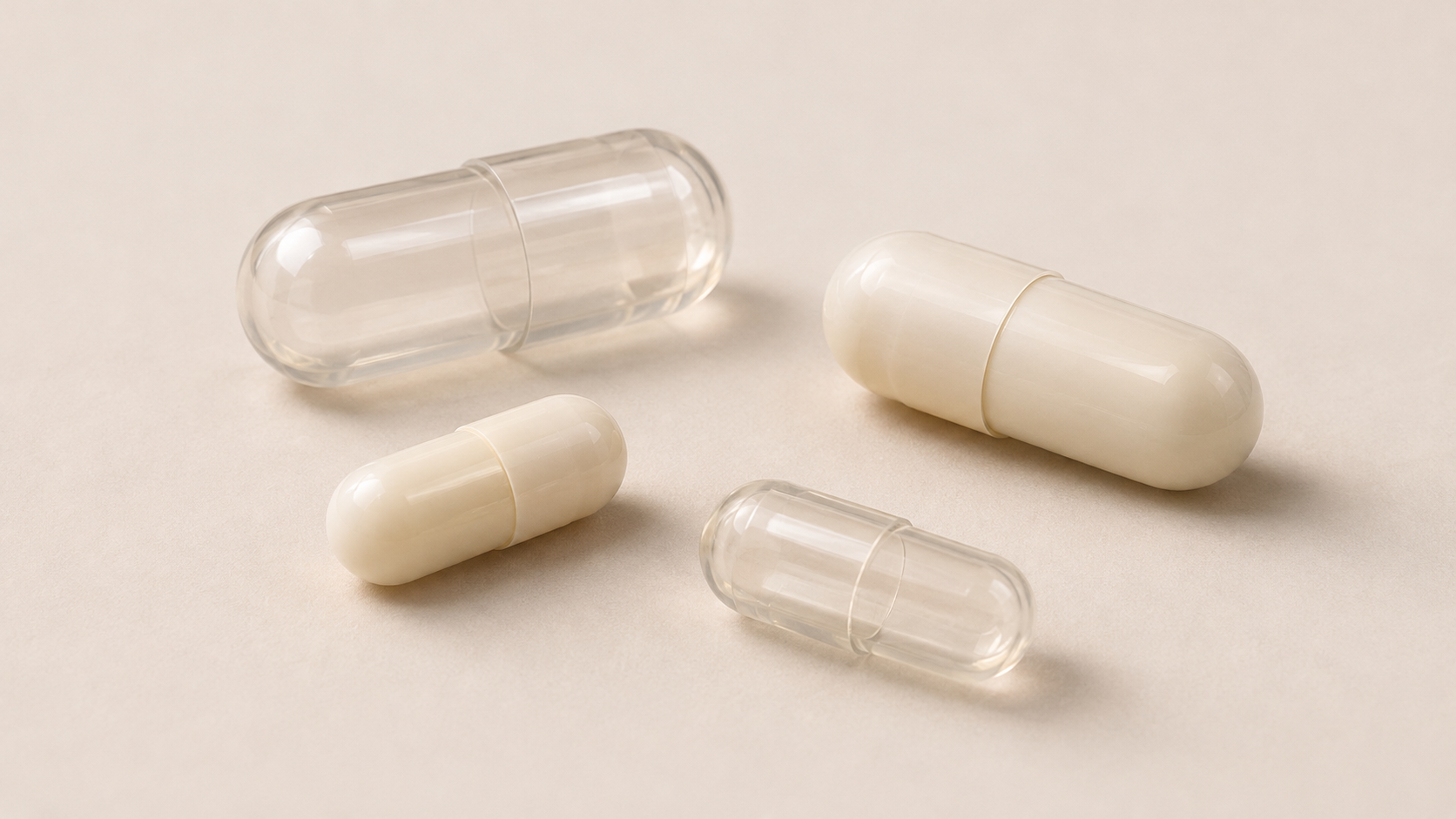
A size 00 capsule is larger than a size 0, but neither holds a fixed number of milligrams. The amount of powder that fits depends on the blend’s density and how it behaves during filling. [1, 2]
For a supplement brand, that affects a practical decision: can the proposed formula fit into one capsule, or will the serving need two? Use the chart to narrow down the options before approving the formula, bottle count or label artwork. This guide covers powder-filled, two-piece hard capsules.
Capsule sizes from 000 to 5
Among the standard sizes below, 000 is the largest and 5 is the smallest. The table uses one supplier’s hard gelatin capsule specifications throughout. Values can differ between suppliers and shell products, so confirm the drawing for the capsule you intend to use. [1, 3]
| Size | Body volume mL | Locked length mm | Fill at 0.40 g/mL mg | Fill at 0.70 g/mL mg | Fill at 1.00 g/mL mg |
| 000 | 1.37 | 25.9 | 550 | 960 | 1,370 |
| 00 | 0.95 | 23.5 | 380 | 665 | 950 |
| 0 | 0.68 | 21.4 | 270 | 475 | 680 |
| 1 | 0.50 | 19.3 | 200 | 350 | 500 |
| 2 | 0.37 | 17.8 | 150 | 260 | 370 |
| 3 | 0.30 | 15.8 | 120 | 210 | 300 |
| 4 | 0.21 | 14.4 | 85 | 145 | 210 |
| 5 | 0.10 | 11.4 | 40 | 70 | 100 |
Reference: Torpac, HC Size Chart 2411. Fill weights retain the supplier’s rounding. Locked lengths have a stated tolerance of +/- 0.4 mm. Body volume excludes the cap dome. Actual fill weights depend on the powder and filling conditions. [1]
The three weight columns explain why a claim such as “size 00 holds 500 mg” is incomplete. You need a density value alongside the weight. Also check what the weight describes: powder inside the capsule, the whole filled capsule, or a particular ingredient in the formula.
Size 0 vs 00
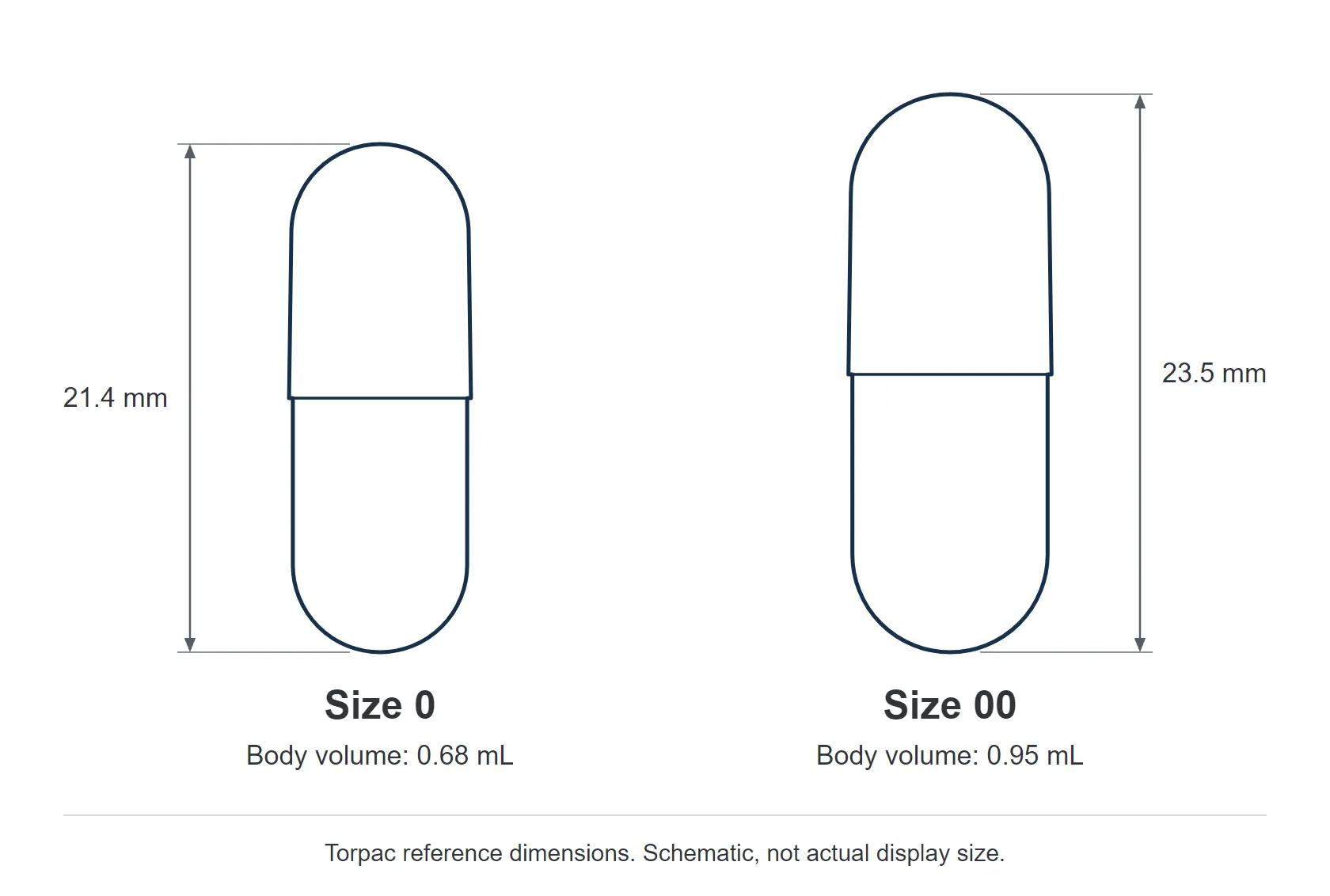
Using the volumes in ACG’s technical chart, size 00 provides about 40% more body volume than size 0: 0.95 mL compared with 0.68 mL. [3] That extra space may let you keep the proposed serving in fewer capsules. It also means selecting a larger shell.
Request physical samples of both sizes before deciding. Review the actual shell dimensions and ask whether your formula can fill consistently at the target weight. A larger capsule gives more room; it does not by itself establish that the finished product will meet its specifications.
Estimate volume from the complete blend
Start with the total powder weight per capsule, including any excipients in the proposed formulation. Ask the manufacturer which density measurement is appropriate for the estimate. Capsugel’s capsule filling guide uses tapped density for powders, then compares the target weight with a supplier’s capacity chart. [2]
For a preliminary calculation:
Required volume in mL = fill weight in mg / (density in g/mL x 1,000)
Suppose your proposed blend weighs 600 mg per serving, including excipients. For this illustrative calculation, assume a density of 0.60 g/mL:
600 / (0.60 x 1,000) = 1.00 mL per serving.
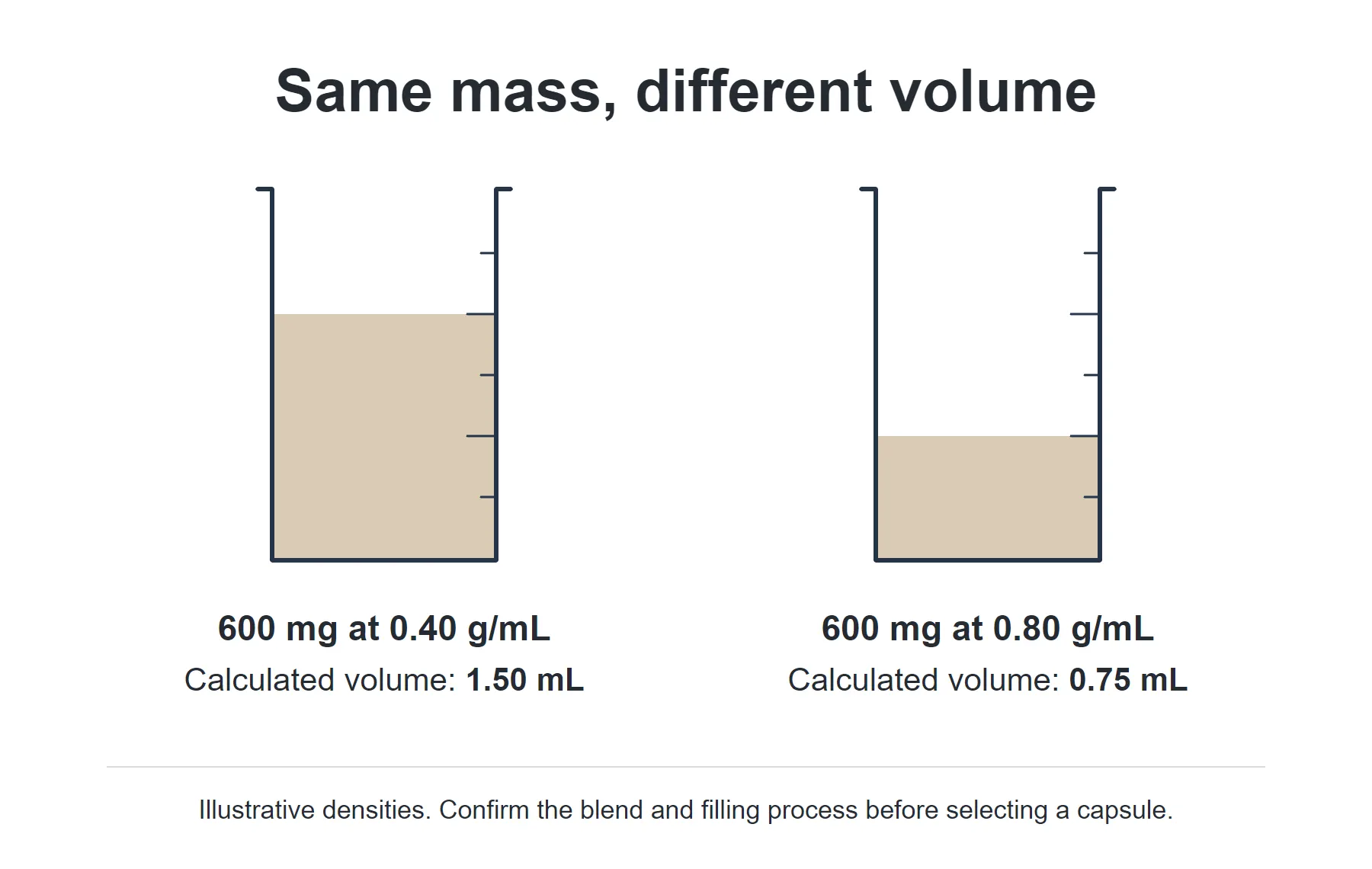
Using the reference volumes above, 1.00 mL exceeds the listed volume of both size 0 and size 00. Splitting that serving into two capsules would mean 300 mg and an estimated 0.50 mL per capsule. That makes two size 0 capsules an option to investigate through a filling trial.
These numbers describe a hypothetical blend, not an Ekang formula or production result. They also assume that the stated density represents the proposed blend for this estimate. If an ingredient or excipient changes, ask the manufacturer to review the calculation again.
The powder needs to feed and compact predictably on the chosen equipment. IMA’s published capsule filling work shows why laboratory density measurements and actual machine performance need to be considered together. A chart can help identify candidates; a trial checks what the blend does during filling. [4]
Keep ingredient amounts separate from fill weight
A product brief that says “500 mg per capsule” leaves room for misunderstanding. Does that mean 500 mg of a named raw material, 500 mg of an active constituent, or 500 mg of total fill?
Write down the ingredient form and the intended amount per serving. Then ask for the proposed total blend weight and the number of capsules per serving. If a supplier needs supporting ingredients to make the blend suitable for filling, those ingredients need space too.
Before you approve a sample, put these values side by side: ingredient amounts per serving, total powder per capsule, and capsules per serving. This gives both teams a clear specification to discuss.
If you already have a formula, send Ekang Nutra your capsule project details. Include your preferred serving count and any capsule size limit so we can discuss the requirements together.
Decide the serving before the bottle count
A smaller capsule may suit your product plan, but it can require more capsules per serving. Consider the customer’s routine alongside the amount of powder you need to deliver.
For example, a bottle of 60 capsules contains 30 servings when each serving is two capsules. At three capsules per serving, the same bottle contains 20 servings. To retain 30 servings, you would need 90 capsules.
That arithmetic matters when you request pricing. Compare equivalent servings and product specifications, then ask the manufacturer to quote the proposed packaging. A change in capsule count should prompt a fresh packaging review rather than an assumption that the original bottle still works.
What to confirm before approving the capsule size
Ask the manufacturer to identify the proposed shell product and size, total fill weight, and expected capsules per serving. Review the selected shell’s specification rather than transferring dimensions from an unrelated chart.
Then agree on what the development sample or filling trial needs to establish. Useful questions include:
- Can the complete blend reach the target fill weight consistently on the proposed equipment?
- Does the capsule close properly at that fill, and what checks will apply during production?
- Will any formula adjustment change ingredient amounts, excipients or the serving count?
- Does the proposed bottle accommodate the agreed capsule count and packaging components?
Keep the approved formula, capsule specification and packaging information together. If one changes later, ask which other decisions need to be revisited before ordering labels or production materials.
Ekang Nutra’s capsule supplement manufacturing service covers powder and granule filling and several hard capsule shell options. Share the product you want to make, including any requirements that are still undecided.
Questions about capsule size and capacity
Can 500 mg fit in a size 0 capsule
It depends on the complete blend. At an assumed density of 0.80 g/mL, 500 mg occupies about 0.625 mL, below the 0.68 mL reference body volume. That makes size 0 a candidate for review, not a guaranteed production choice. Capsugel uses this combination as a sizing example. [2]
Can I use the chart for HPMC capsules
Use it to understand the relationship between size, volume and fill weight. For the actual dimensions, obtain the specification for the selected HPMC shell. The table in this article reproduces hard gelatin capsule data. [1]
Can I choose the capsule before the formula is finished
You can set a preferred size as a development target. Tell the manufacturer whether that preference is flexible. Final approval should follow review of the complete blend and the proposed filling process.
What if the formula needs too many capsules
Ask the manufacturer to compare a larger shell with the current serving plan. If the serving remains impractical, revisit the product specification with the formulation team. Any change to ingredient amounts should be an explicit product decision.
Discuss the size your formula needs
To start a capsule project with Ekang Nutra, send your formula or product concept, ingredient amounts per serving, preferred shell and target capsules per serving. Add the intended sales market, bottle count and estimated order quantity. If you do not yet know the powder density, say so in the brief.
Discuss your capsule formula with Ekang Nutra to review the project requirements and the next steps for sampling and a manufacturing quote.
Sources
[1] Torpac: Empty Hard Gelatin Capsules Physical Specifications, HC Size Chart 2411. Source of the table’s dimensions, volumes, rounded fill weights and footnotes.
[2] Donald K. Lightfoot, hosted by Capsugel: Answers to 10 Common Questions About Capsule Filling. Reference for using formulation density and target fill weight to estimate capsule size, including the 500 mg example.
[3] ACG: Capsules nutraceutical brochure, technical specifications. Reference for standard capsule sizes and body volumes. The 40% comparison is calculated from 0.95 mL and 0.68 mL.
[4] IMA Group: Accuracy, productivity and cleanliness in nutraceutical capsule filling processes. Reference for the relationship between powder measurements, equipment settings and filling trials. Its reported results belong to IMA’s case study, not Ekang Nutra.
Company service information: Ekang Nutra capsule manufacturing. Sources checked November 19, 2026.