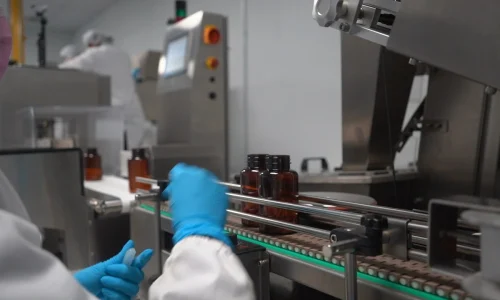
Packaging & manufacturing
A stick pack is convenient to carry, but producing one involves more than putting a tub formula into a smaller package. The powder has to feed consistently, the film has to protect it, and the seals have to survive handling without leaking.
When choosing a stick pack supplement manufacturer, start with your finished blend and intended serving size. Then confirm the pack dimensions, filling process, and packaging costs. A format that works for a small electrolyte blend may need a different setup for a bulky collagen or greens powder.

A stick pack lets customers carry a pre-portioned amount of powder without a scoop.
When single-serve packaging makes sense
Stick packs suit products that customers take to work, carry while traveling, or keep in a gym bag. They remove the need to measure powder with a scoop. Sample kits and variety packs also let customers try a flavor before buying a larger supply.
For subscription products, individual packets can make portioning and packing orders straightforward. Shipping savings still need to be calculated using the complete retail pack, including its carton or outer pouch. A lightweight individual stick does not guarantee a lower delivery cost for the same number of servings.
Convenience also depends on use: the pack should tear cleanly and empty easily. For drink mixes, test it with the bottle or glass customers are likely to use.
Stick packs and sachets are different formats
A typical stick pack is a narrow tube with a longitudinal seam and seals at both ends. A flat sachet is usually wider, with a different seal layout. Suppliers sometimes use the terms loosely, so ask for a pack drawing and samples rather than relying on the format name. Viking Masek’s stick pack machine overview shows how the film forms a tube before the longitudinal and cross seals close it.
The distinction affects the equipment, opening width, and space available for the powder and label. A manufacturer that fills flat sachets should confirm whether it can also produce the narrow stick format you want.
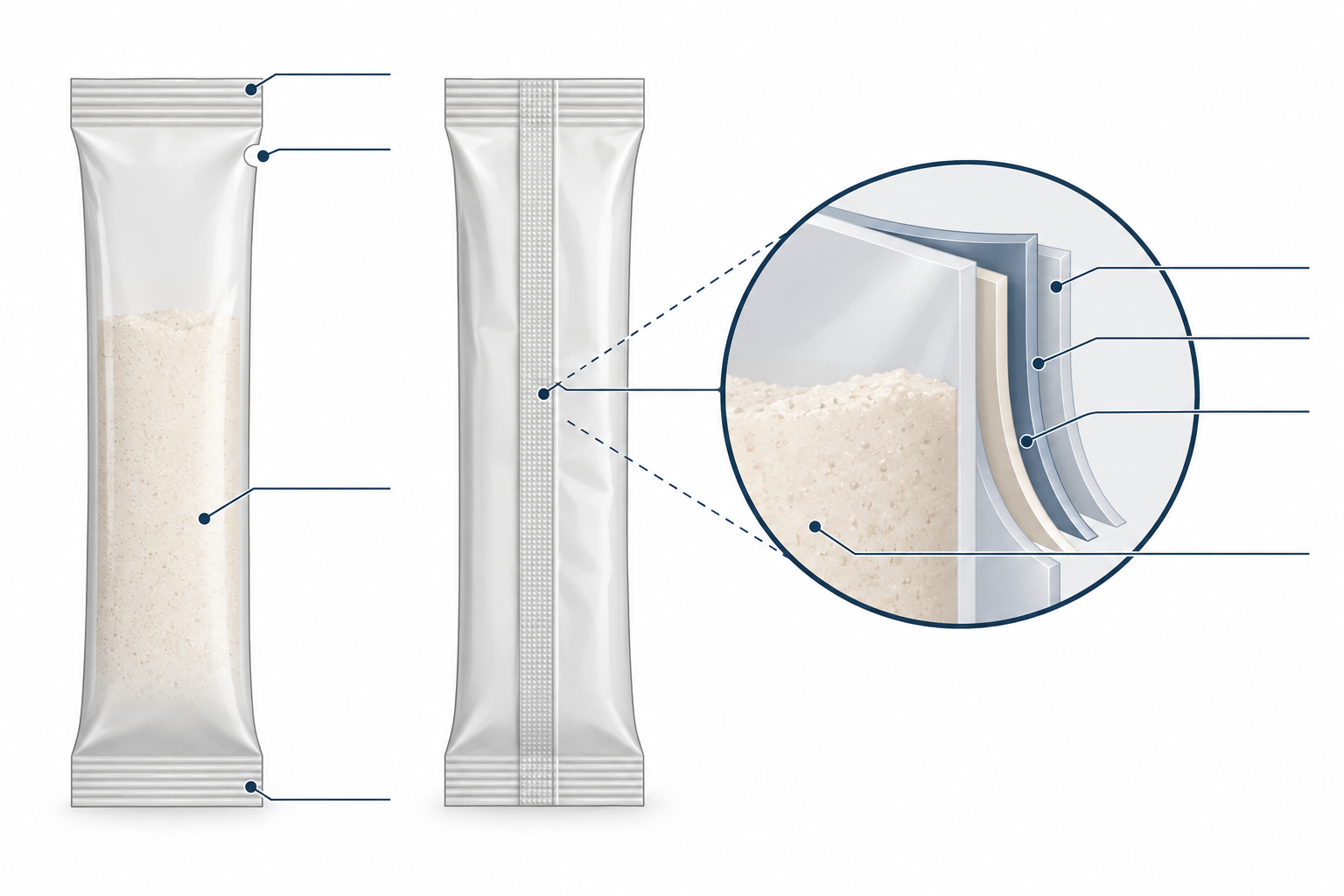
The longitudinal seam and both end seals need to remain intact through storage and handling.
Check the powder before choosing the pack size
Fill weight alone does not tell you how much space a powder needs. Bulk density and the way the powder settles during filling affect its volume. Include the entire blend in the assessment, including flavors, sweeteners, and carriers, rather than sizing the pack around the main ingredient alone.
There is no universal gram limit for stick packs. The usable volume depends on the pack dimensions, filling equipment, powder behavior, and space needed to keep the seal area clear. Larger servings may work in a wider stick or sachet; a tub or bulk pouch may be more practical if the serving becomes awkward to open and pour.
Request a trial with the intended blend before approving printed film. Review powder flow, pack fullness, and how much material remains after pouring. These are the kinds of product and package details equipment suppliers request during packaging feasibility reviews.
What to check in powder stick pack manufacturing
Fill weight and ingredient content
Pre-portioned packaging removes customer scoop variation. It does not guarantee that every packet contains the correct amount of every ingredient.
The manufacturer needs controls for both net fill weight and blend uniformity. An uneven blend can produce packets with similar weights but different ingredient concentrations. Segregation during transfer or feeding also needs attention, especially for ingredients present at low levels.
Ask how the sampling plan covers the production run and, on a multilane machine, the different filling lanes. Confirm the weight limits, how packaging weight is excluded, and what happens to product made when a check fails. Discuss ingredient-content verification separately from weighing. FDA’s dietary supplement CGMP guidance covers specifications for production, finished products, and packaging, along with verification that those specifications are met.
Barrier film and shelf life
Select the film for the formula’s sensitivity to moisture and, where relevant, oxygen and light. Request water vapor transmission rate (WVTR) and oxygen transmission rate (OTR) data as appropriate. Compare results using the same units and test conditions: temperature and humidity affect barrier measurements. AMETEK MOCON’s testing guidance
A film data sheet does not establish the finished product’s shelf life. The formed pack, seals, storage conditions, and powder all matter. Assess stability in the intended package rather than assuming that results from a tub transfer directly to a stick pack.
Individual packs avoid repeatedly exposing the remaining servings when a bulk container is opened. That benefit still depends on sound seals and an appropriate barrier. Our guide to powder supplement manufacturing issues explains related moisture and clumping problems.
Seals and opening performance
Powder caught in a seal can prevent the film surfaces from bonding properly. Dust control and a clean seal area deserve attention alongside the sealing settings. Packaging equipment maker Viking Masek describes this problem in its powder dust-control guidance.
Agree on checks for both seal strength and leakage, using methods suited to the package. A neat-looking seam is not proof that it is leak-free. Check samples during the run, including after adjustments, and assess opening and pouring as part of the packaging trial.
Compare costs at the retail-pack level
Single-serve packaging can cost more per serving than bulk packaging. Request a quote that separates formulation or blending, printed film, filling, testing, and secondary packaging. Include setup charges, production losses, and freight when comparing options.
Ask for the minimum order quantity for each flavor and artwork version. The film supplier’s minimum and the manufacturer’s production minimum may differ, leaving you with unused printed film. Confirm who owns that stock and how it will be stored.
Sampling is a smaller commitment for the customer. It does not necessarily make a stick pack launch cheaper for the brand. Before ordering, compare the total cash required and the number of saleable boxes you will receive.
| Format | Useful when | What to check |
|---|---|---|
| Tub with scoop | Customers use the product regularly at home, including larger servings | Scoop variability, closure performance, and protection after opening |
| Resealable bulk pouch | You want a flexible pack with multiple servings | Barrier properties, seal and zipper performance, and access for scooping |
| Stick pack | Portability and a narrow opening suit the intended serving | Blend flow, available fill volume, seam integrity, and cost per serving |
| Flat single-serve sachet | A wider packet or opening better suits the powder | Equipment compatibility, usable volume, seals, and pouring performance |
On small screens, scroll the table sideways to compare all columns.
A bulk pack and a single-serve version can serve different purchasing needs. Qualify each package rather than treating the second format as an artwork change.
Be specific about sustainability
Compare packaging for the same quantity of product or number of servings. Include all individual wrappers and any outer carton or pouch. A stick pack’s low weight on its own does not establish that it uses less material than a tub on that basis.
High-barrier laminates can be difficult to recycle, and a mono-material film is not automatically accepted by local collection systems. Assess the complete package and the recycling options available where it is sold. For U.S. marketing, the FTC’s Green Guides advise against broad, unqualified environmental claims and call for qualifications when access to suitable recycling facilities is limited.
If you change film to meet an environmental goal, repeat the relevant sealing, barrier, and packaged-product checks before approving it.
Questions to settle before approving production
Ask the manufacturer to document:
- The proposed pack dimensions and results from filling your blend.
- Fill weight limits, the sampling plan, and ingredient-content controls.
- The film specification and how seal performance will be checked.
- Stability support for the intended package and storage conditions.
- Minimum orders by SKU, film commitments, and the full cost per retail pack.
- Which operations take place in-house, which use outside partners, and who releases the finished batch.
- The approved artwork, lot-code placement, and a schedule that includes material procurement and testing.
Review labeling for the intended sales arrangement, particularly if individual sticks may be sold or distributed separately from the outer box. Settle the available label space before committing to the pack dimensions.
Frequently asked questions
Are stick packs only for powders?
No. Suitable equipment can also fill liquids and gels. A powder-filling line does not automatically have that capability, so confirm the process for your product. This guide focuses on powder supplements.
Can a large serving fit in a stick pack?
Possibly. Assess the complete blend’s volume and filling behavior against the manufacturer’s available pack sizes. A wider sachet or bulk container may be easier to use if the serving is too bulky for a narrow stick.
Do stick packs have a shorter shelf life than tubs?
Not inherently. Formula stability, package barrier, seals, and storage conditions determine performance. FDA’s dietary supplement CGMP rule does not require an expiration date, but its guidance says any date used should have supporting data.
Can we use the same formula in a tub and a stick pack?
Potentially, if it fills reliably and performs as intended in both. Confirm the ingredient amounts per serving, package-specific stability support, and labeling. Reassess those points if a processing change or added excipient alters the formula.
Are private label stick pack supplements suitable for a small first order?
Ask for a project-specific quote. An existing formula may reduce development work, but film minimums, filling setup, and carton quantities still affect the order commitment. Do not assume that offering sample packs means the manufacturer offers small production runs.
Discuss your stick pack project with Ekang Nutra
Ekang Nutra manufactures powder supplements in Chino, California, and offers powder packaging options that include stick packs and sachets. Our certifications page provides information about FDA food facility registration and Eurofins cGMP certification. Review the current documents and confirm the operations included in your project.
Send our team your formula or product brief, target serving weight, planned quantity per SKU, and preferred pack format. We can discuss packaging feasibility and prepare a quotation for the agreed scope.